
Silence. No roadmap. No timeline.
That's estrangement. And that's exactly why reconciliation never happens on a schedule — or on both sides at the same time. Which in my experience and what people have told me is almost always.
A friend asked me a solid question after my last post about transconciliation™. What happens when both people define transformation differently? What if one person thinks the other hasn't really changed enough?
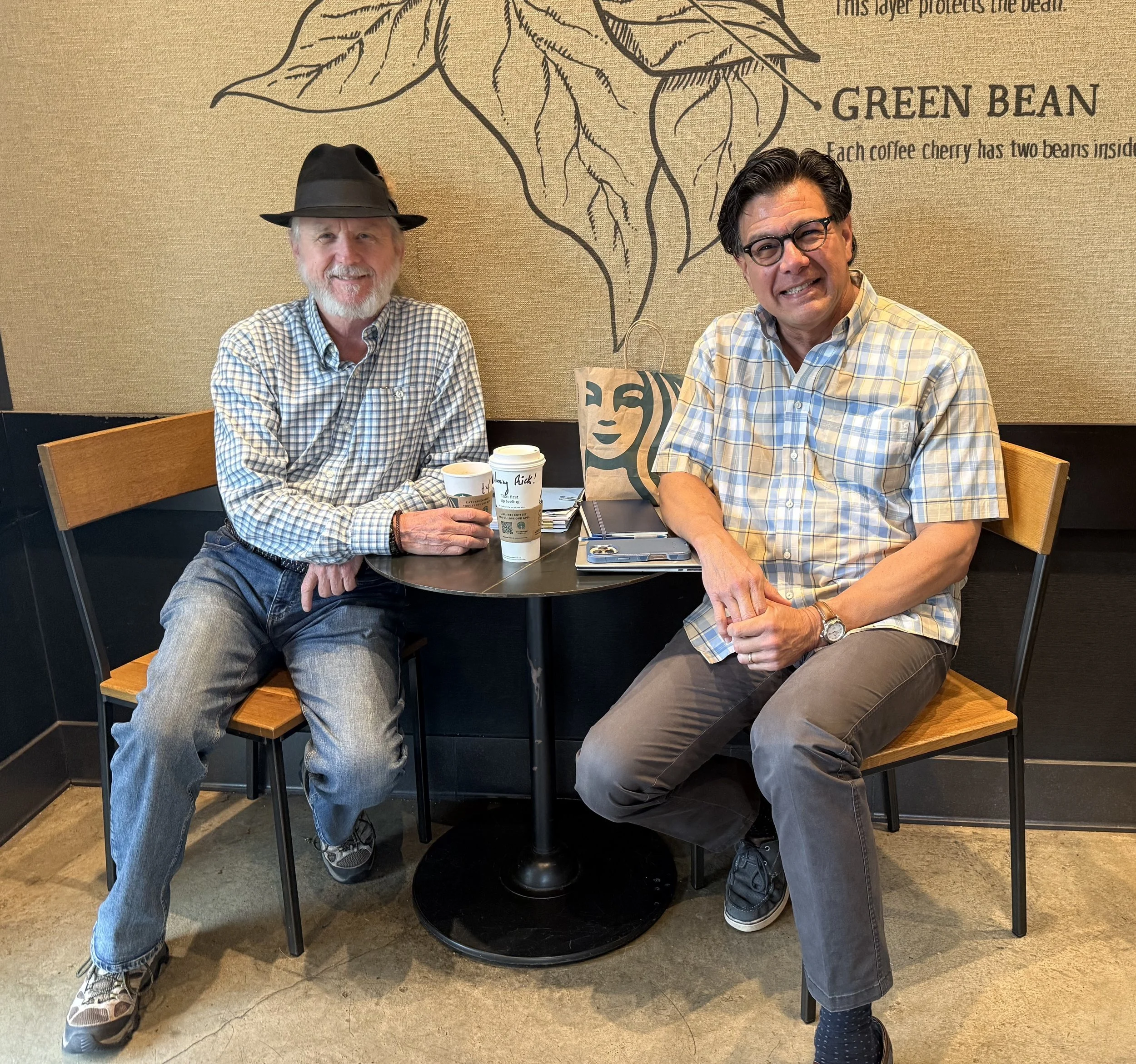
The conversation that started it all. Ray Tye (left) and Rick Ramirez (right), Starbucks, September 2025.
It's a fair question. And it points at something worth sitting with.
Here's what twenty-five years of silence taught me: you don't have to arrive together. In fact, you almost certainly won't. And that's okay.
Estrangement is like two people walking separate trails through the same mountain range. You can't see each other. You don't know how far the other person has come, or whether they've turned back. You just keep walking your own path, and somewhere — maybe years apart — you both come out on the other side.
My dad and I were estranged for twenty-five years. We talked some over the years, but not much, and less and less as time went on. By the last decade, there was really nothing. Just silence. The kind that gets heavier the longer it sits.
The kid who chose to leave at fourteen wasn't who I was anymore. Surviving does something to you. So does the Marine Corps. So does building a life from scratch and watching it slowly become something real. Somewhere in all of that, without any particular intention, a different person emerged. Not better, necessarily. Just different. Older in the ways that matter.
My father was walking his own trail the whole time. When we finally found each other again, neither of us said a word about the journey. We didn't compare notes. We didn't audit each other's transformation. We just recognized something in the other person that hadn't been there before — or maybe had always been there, buried under all that old weight — and we let it happen.
That's the part nobody talks about. In a long estrangement, you're each living in complete isolation from the other. The silence creates its own momentum. One person may get to the other side years before the other. That's not a failure. That's just how it goes.
Transconciliation™ doesn't ask whether both of you have changed. It just asks whether you have changed enough — however and whenever that happened — to move toward something honest. That's the only question you can actually answer, because it's the only one that's yours.
When both people have genuinely gotten there — even years apart, even without ever discussing it — what follows is honest. Not a handshake. Not a truce. Something that actually holds.
I eventually realized that at different points, my father was walking ahead of me, then behind me. At the end, he was walking beside me, and I was holding his hand.
My dad and I didn't have much time left after we reconciled. But what we had was honest. And we discovered that we genuinely liked each other. That's what I'll carry.
If you're somewhere in the middle of a long estrangement right now: don't wait for the other person to signal they're ready before you take an honest look at who you've become. You may be waiting forever. And wherever you are in that process is yours — regardless of how it ends.
